Showing posts with label OI Vietnam Magazine. Show all posts

Saturday, 19 December 2015

St. Josephs Cathedral. Hanoi


A little corner of Paris in Hanoi

'Let's meet outside the 'big church' near the lake' I said. What a surprise I got when I arrived.

On previous visits to Hanoi I had somehow managed to miss St. Joseph's cathedral. I must have been too busy dragging around the 'big' tourist spots or losing my way in the maze of streets of the old quarter. But, this time, determined to find the 'big church'  I arranged to meet a friend there to do some sketching together. I was early so I was able to soak in the unexpected atmosphere of this quiet corner of the capital city for a little while.

As soon as I entered the secluded square which is dominated by the modest facade of the church, I was transported back twenty years to a misty evening spent in Montmartre in Paris. The church bells marked the quarter hour. There is something about the scale of the buildings, the layout of the streets and the crooked trees that is reminiscent of that romantic quarter of Paris that was the haunt of so many artists. There are the same muted colours of green, grey and browns and I began to imagine that this collection of streets and bars in Hanoi could easily be the centre of a modern day art movement for the talented young artists of modern Vietnam if they wished.

The church itself is rather underwhelming in scale. It is styled on the massive Notre Dame cathedral in Paris, as is Notre Dame Cathedral in Saigon. It was built in the 1880s on the site of the demolished Bao Thien Pagoda, an ancient and sacred meeting place which, coincidentally, had been constructed about the same period as the Paris cathedral.

In front of St. Joseph's is a charming railed garden that is home to a small statue of the virgin Mary 'Queen of Peace'. But I suspect that this corner of Hanoi has not always been a haven of tranquility.

There must have been protests and riots when it was declared that the old Pagoda was to be demolished to make way for the 'new religion' of the invading French. Hearts will have been broken as 700 years of tradition and community was so wilfully destroyed.  Later, in 1954 when the Viet Minh took control of Hanoi, the church and all its property was confiscated. It was  over 40 years before the church was, once again, permitted to reopen for services. Then, in 2008 there were more protests, this time by Catholic priests who demanded the state return land that had previously been occupied by the church. Maybe it is the fear of more conflict that caused the church and the little Madonna to both be surrounded by protective railings.


Today, this square is peaceful. The street that leads to the church( Nha Tho) has a collection of international restaurants, local cafes and shops housed in two slightly faded rows of pretty shop houses and many have been there for many years. My friend says that nothing much changes in this neighbourhood where he founded his business nearly 20 years ago. 

The bells chime the hour with that flat two-tone of every church in France, big or small. It all adds to that haunting feeling that I could easily be walking those cobbled streets of Montmartre once more.

Monday, 13 January 2014

Creative inspiration


People often ask where artists get their inspiration from, how and why do they start a piece of work and why do they choose to draw or paint the things that they do.  

When it is asked of me, I am always struck dumb (temporarily)because the answer is so complex. When people stop to look at my work while I am drawing in the landscape they sometimes as - "how long did it take you to do that?"  Should my answer be "three hours" or should my answer be "fifty years"? As to the 'why' - well that is much more difficult. Every one of us has unique experience of life. Each artist has a unique perspective on the people, places and events they encountered or experienced in a lifetime. Here are my thoughts about how the artist develops from childhood.


When a child starts to draw at the age of two or three, every single mark made on the paper is of equal importance. 

By five they see that people look different and so give them different features like long or short hair but houses are still all the same. By seven or eight they will include landscape and weather to give context to their characters but the houses are still the same.


By nine the young artist is drawing on their own observations and start to create recognisable compositions of places and things that they know, have seen or, maybe, in response to recent events. 


Now that the young mind is taking in everything that is going on, they are gathering image and sensory memories . They are interested in the creations of others and become fans, or followers of different styles. These influences are also stored in the memory banks of the mind.


With every drawing, a path is being carved between the eye, the creative corridors of the mind and the hand. They start a conversation that is sometimes led by the hand and sometimes by the mind. 


Sometimes the hand makes a mistake or 'does its own thing' and the mind quite likes the result. other times, the hand is a slave to the mind's intent. 


As the young artist experiences more emotions. the heart also become part of the conversation.  


When we mature we seek the input of others and they too become part of the conversation.  All the while, the artists is storing away images and sensations that can be drawn on at any time.  The memory banks are growing in size every year. 

As the artist ages, the memories of images become more detailed and the banks grow every hour and minute. It can become overwhelming.


So how do artists draw on these memories and inspirations?  Memory banks are not like a library; you cannot  do a search by subject because the categories are infinite and the languages used to store them are those of the hand, the eye, the heart and all 19 senses. The only tool that can sort them out is the subconscious and this seldom works on command.

I access my subconscious every morning in that precious time between waking and rising.  As I become conscious, I lay on my back and stretch my spine and limbs as if on the rack. I use a small pillow of seeds and perfumed oils to support my neck. Sometimes I am naked, sometimes my sheet has to be perfectly smoothed over me. I don't decide - something inside decides.

Now I start to think about the task for the day ahead and soon my imagination, directed by my subconscious, takes over. They talk for about an hour and then it is time to start work while the inspiration is fresh. Breakfast can wait.

Alexndra waking by Laura Lacambra Shubert


Monday, 11 November 2013

Upcoming Christmas Exhibition

I am taking part in this year's exhibition of 'Small Things' at Vin Gallery; their annual show of smaller works of original art in time for Christmas. 


Published in the May issue of Oi Vietnam, this was my very first magazine column. 
Read the story here

This is still, probably, my favourite postcard and was originally produced to illustrated the Full Moon Festival in my book about Hoi An.


This postcard illustrated my column in the July 2013 issue of Oi Vietnam which tells the story of my first shopping experiences in a local wet market when buying ingredients for a slightly ambitious Vietnamese birthday feast!
I addressed it to Rick Stein, the chef and restauranteur in Padstow, England

Oi Vietnam Magazine


This postcard was published in my book 'A Week in Hoi An' and shows the view of the Cham Islands from An Bang beach on a spring day. This is address to a little friend who likes to visit this beach from time to time.


The story about the magic and mystery of the My Son ruins was published in the June issue of Oi Vietnam Magazine. The memory of this evocative and poignant trip still haunts me.

Oi Vietnam on Facebook


If you take the late overnight sleeper train from Saigon to Da Nang, you are awoken by the breakfast trolley at dawn just before the train arrives in Nha Trang. 

From this point on the train hugs the coastline and you can watch the sun rise over the many islands scattered along the coast of the East Sea. Oi Vietnam Magazine, August 2013 issue.

This is addressed to my friend Robert who loves travelling by train.


Addressed to the late Antoni Gaudi, architect of Barcelona, this postcard illustrates some of the lovely shop houses of Saigon. One day these shops will be as fashionable to live in as their counterparts in Singapore.

Oi Vietnam Magazine - September 2013
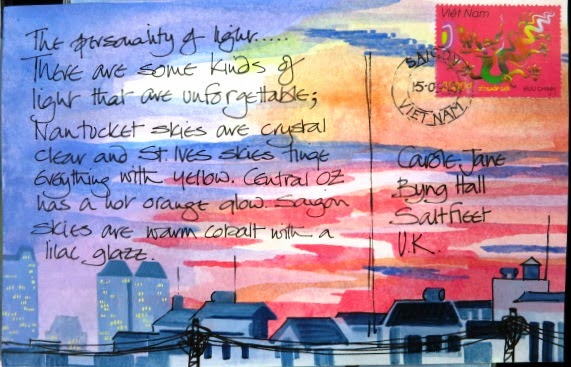
Vietnam skies are amazingly beautiful. the colours are off the scale for depth of hue and luminosity. because the land is so flat along Vietnam's coastal, delta and southern regions, you can see weather coming for miles and miles. If you stand on Thu Thiem Bridge on a changeable day, you can see rain storms happening in different districts of the city and feel the rush of wind that preceeds every shower that is going to drench you! Read the article

I addressed this postcard to my sister who loves changeable weather and lives under her own big sky in Lincolnshire in England.

So, pop along to Vin Gallery on Friday evening to see these little gems in the flesh. They are beautifully framed in mahogany with double glass and floating mount. they would make a lovely present to a friend or even to yourself!