Saturday, 22 March 2014

Love it or lose it


Central Phnom Phen

 In this part of the world, you don't have to look very hard to find evidence of the part played by France in Vietnam's history.  Many of the key buildings of state were erected by the French.

But, it wasn't until my visit to Phnom Penh, in Cambodia, that I became aware that there is some concern about the possible loss of the architectural heritage left by the French in South East Asia.  

That weekend I read, in the Phnom Penh Times, that there are two points of view when it comes to the older buildings there. One side values the history, culture and architectural beauty; the other values the real estate and the possible financial gain from redevelopment of the large city centre sites occupied by these 'grand old ladies' of architecture.


Decaying French architecture 

Of course, Saigon simply wouldn't have the same charm without the old Post Office, the Opera House, the old L'Hotel de Ville that is now home to the People's Committee.  Apart from the glory of their elegance that is evocative of another age, each one of these buildings has a fascinating story to tell.
The former Hotel de Ville - Saigon

L'Opera -Saigon

But there is a less conspicuous legacy of little merchants' shop houses that give the streets of Saigon their unique character. The oldest of these modest buildings are now 150.  

Some have been loved and maintained but many are suffering the ravages of time and crumbling or disappearing behind giant hoardings and modern concrete 'embellishments' and extensions. 

Central Post Office - Saigon


The three storey shop houses adjacent to Ben Thanh market (below)are an example of this kind of treatment. If the advertising companies, sign makers and property owners are allowed to continue defacing, disguising and disfiguring Saigon's architectural heritage, these buildings will be lost and the character of this iconic area will be changed forever.


As humans, we collect the memories and souvenirs of all the people and events that have influenced or changed our lives. It is the nature of people to want to hold on to some aspects of the past - it can give us a sense of belonging and it confirms out identities. 

For this reason, many people are unsettled by too much loss and change. Our favourite cities are just like people, they are a collection of souvenirs that represent all the different cultures, religions, political regimes, nationalities and trends all leave their traces behind as they pass through. These traces remind us who we are.


Many townscapes in the west have suffered at the hands of careless town planners who erased neighbourhoods and demolished old buildings in their town centres to make way for modern, concrete shopping malls and car parks. The wounds left behind have, still, not healed. People can feel demoralised and lose their sense of place. Sometime 'we just don't know what we have lost until it is gone'. 


But cities that have cherished their unique tapestry of architectural styles through the ages are warm, vibrant, welcoming and interesting to all.  Those who have filled their towns with concrete are regretting the loss of history now. 


Former shop houses in Singapore's city centre

In Singapore, properties like the old merchant houses that line the broad avenues of Saigon, are being renovated and turned into comfortable homes by young professionals. Maybe it will be a while before the young Vietnamese develop a taste for this style of living.  In the mean time, it is everyone's duty to preserve this cultural and architectural heritage so it can be enjoyed by the next generations.


Saturday, 15 February 2014

The song of Vietnam

It has been a very noisy two weeks here in Hoi An.

Starting on January 23rd we had the Lunar New year festival, locally known as Tet which starts quietly with families burning ceremonial paper clothing, money, shoes and   poems in pots on the street outside their homes. In this ceremony they are sending the kitchen god up to the heavens to report on the behaviour and activities within the home over the past year. 


Our landlady (whom we call Auntie) came to the house with her brother and one of his daughters and the youngest son.

They brought with them a feast of whole boiled chicken, spring rolls, rice and cold meats. There were five fruits, flowers and new joss sticks for the altars in the garden, in the kitchen and upstairs in the studio.  They burned ceremonial paper goods in the lane outside the house and the kitchen good was sent off to speak with the Jade Emperor for a week.  The kitchen god  likes to ride on a red carp and some people throw fish into the rivers to send the kitchen god on his way.

  • The release of the strong-swimming carp into local ponds, rivers and lakes, is believed to transport the Kitchen God to heaven. After delivering the God, the carp transforms into a dragon.
  • It is said that the God will then report to the Jade Emperor on the life of homeowners and pray for luck, happiness and prosperity for all members of the house in the coming year.
  • The Kitchen God returns to Earth on New Year’s Eve (February 9 this year) and resume his duties as the caretaker of Vietnamese kitchens.

Throughout all this, the Vietnamese, who love to sing, hold Karaoke parties in their homes and at local cafes.  they don't care how loud or how badly they sing; they just sing their hearts out. The older generation remember a time when public singing and public music was not allowed so now they make the most of the freedom to sing and celebrate. 

Tet lasts about a week ( or so) and on the last night they really let rip! A party at end of our lane was so loud that the windows rattled in the studio and the water in my pot rippled! At 9.15 everything stops like nothing ever happened. That is the one great thing about this country - everything stops before 9.30 and the streets go quiet.  

Huge lanterns blowing the evening breeze

This week, 14 days after the New Moon, we had Full Moon night in Hoi An. I have never seen the streets so busy. We had to fight our way through the crowds to get from one end of Tran Phu to the other. On these nights there are no electric lights allowed in the streets apart from the lanterns. The waterfront was completely dark apart form the odd candle-lit table in a cafe and oil lamps on the boats. it was magical.


Table altar outside the bookshop


A gallery owner tends his altar on the street outside his shop and makes offerings.


Lantern lit riverscape
Music filled the streets and the young people and families promenade in the crowded streets to see the sights. We listened to classical guitar on one of the boats moored along Bach Dang waterfront and ate near the Japanese bridge where we watched town elders playing Chinese chess dressed in traditional silk pyjama suits.


Two days later and its time for a feast at the local temple. we arrived to see tables laid out with fried spring rolls, fatty roast pork, boiled pork and blood cakes, salad and white garlicky sausage. Larue beer flowed freely and the old men went from table to table shaking hands and topping up everyone's glasses.


Everyone in the neighbourhood gathered, took a seat and enjoyed the feast. more food was brought in waves - now baguettes, now bean sprouts, more salad and bowls and bowls of pork broth. Everyone is laughing and drinking.The old men offer cigarettes around the table.


Mot Hai Ba Yo!

Mr. Hung had been on the sauce since breakfast I reckon. With his larger than life personality he missed his calling in Chinese opera!


The lady below is 84 and has a beautiful set of painted black teeth but she was reluctant to give me a smile.  


This guy arrived at out table to show off his skills by making a bird and a grasshopper out of palm leaves. We gave them to as little boy and girl.


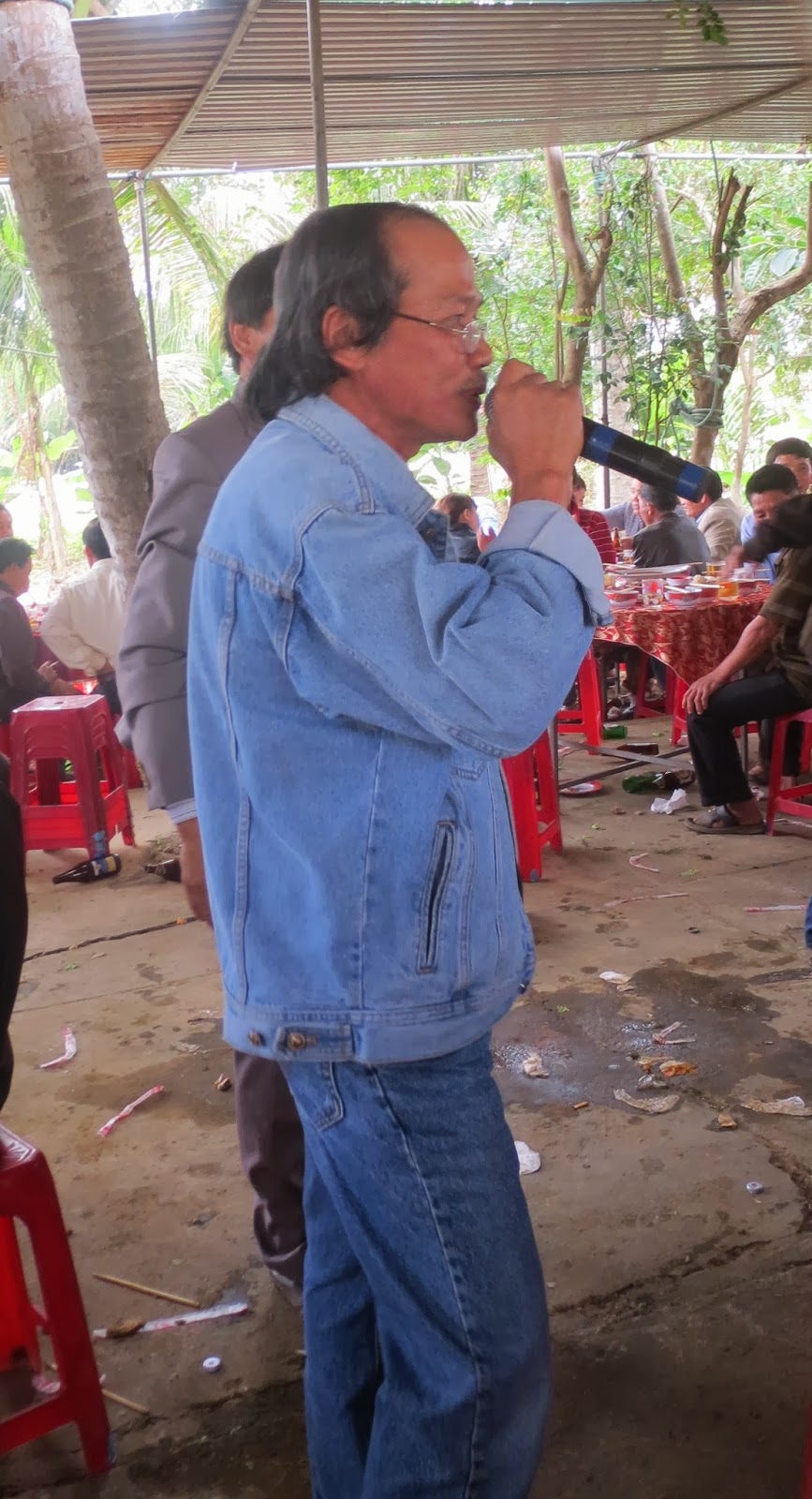
A woman with a beautiful voice stood up to since a traditional song without any accompaniment. Everyone was quiet for a little while.  Then the men started to sing and a boy band was formed. Finally all the singers sang a popular song and the entire party clapped along in rhythm.
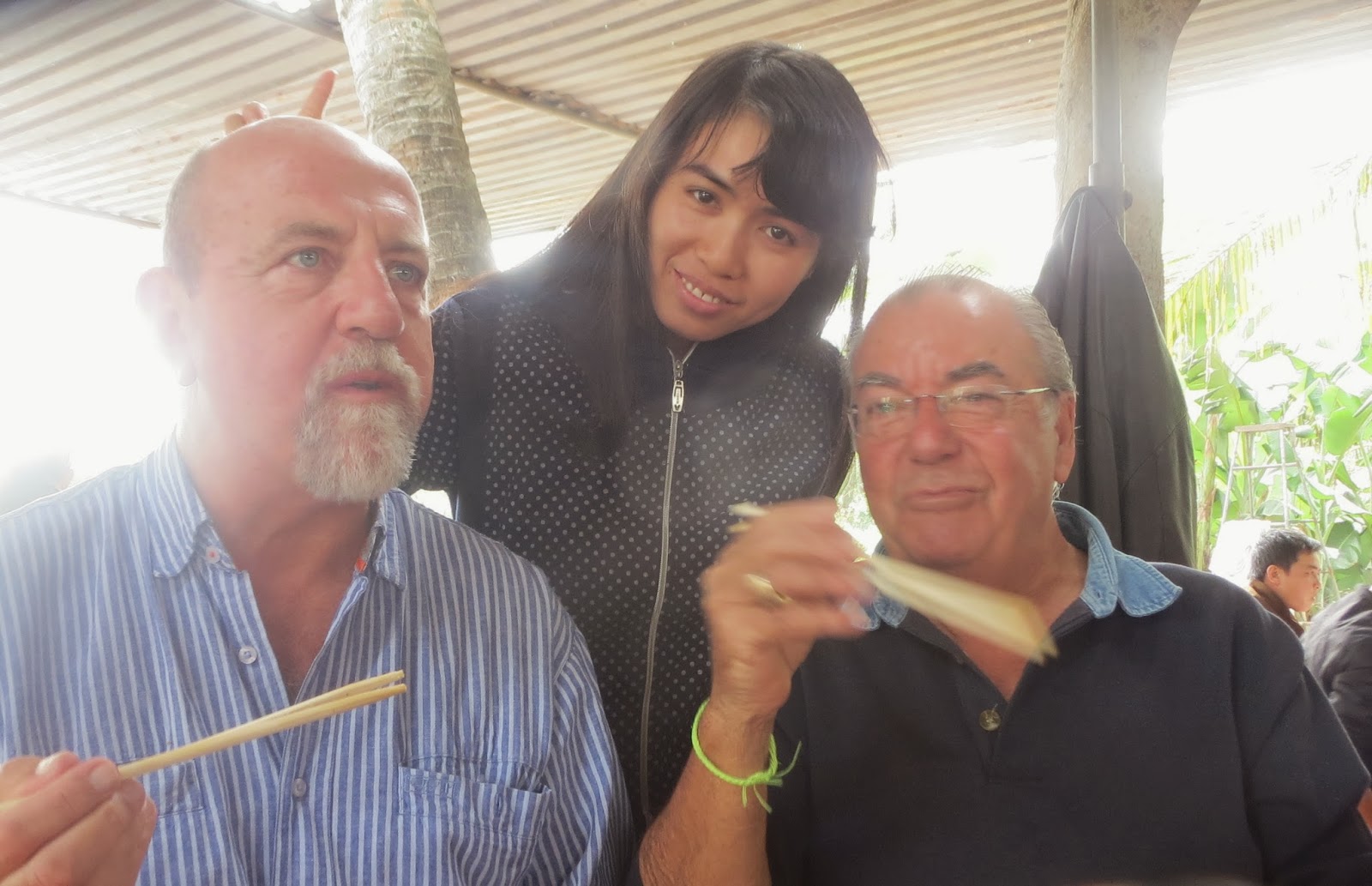
Here is Phuong and her lovely husband (below). 


Their family is in the middle of a funeral. An uncle died suddenly and the funeral ceremonies last for seven days.


 The lonely wail of a single stringed  'violin' has been winding its way around our little streets for two days, occasionally interspersed with the slow drum and gong rhythm that seems to signify a vigil. 
This morning at 4.30am, the saddest song founds its way into my room; an unusually melodic song of a male choir that really chilled me. I couldn't sleep again.  

Here is Phuong with Robert and Bill. 


And.... Robert with another lovely local.

I don't think I have ever attended such a jolly party in my life. These lovely people laugh and sing with abandon. I danced with one of the girls and came close to taking the mic to sing them a traditional song from the UK. That must have been the beer!  A good time was had by all and the party continued long after we left. 

Back home, the drunken singing from compete parties is drowning out the ever-present funerary dirges which will last for another two days I believe.

Saturday, 1 February 2014

My love of boats


I am passionate about boats. I love to draw them and back home in England I even lived on one for 10 years. I can sit and watch boats bob about in a harbour for hours. Just listening to the slap of ropes on masts and watching fishermen mend nets and wind ropes fills me with delight. One of the big benefits of living near the river or the coast in Vietnam is being able to enjoy a seemingly endless variety of traditional wooden boats and ships that move along the canals and rivers and gather in harbours along the coast.

I reckon I was born with some salt water in my veins because my mother’s family were seafarers in the north of England. I can just about remember wooden sailing boats coming and going in their home town but sadly the fishing industry is almost extinct in the UK which is a sad loss.

Here in Vietnam, however boats still form a major part of the transport systems internationally, nationally and locally. Whether you want to ship rice to Australia or take your chickens to market, boats are often the best way from A to B. Many communities in rural areas are only accessible by boat so the rhythms of the tides, the winds and the rain are the factors that set the pace of life.

Here are some of my favourite things to do on the water...........

I like to take a little wooden boat down the river in Hoi An at the end of the afternoon and return to the quay side by the market just as the sun is beginning to set. The low afternoon sun casts a warm glow over the ancient town and paints beautiful reflections in the silken waters of the river.


The thrill of taking a speed boat up the Saigon River to Cu Chi is hard to beat as way to spend a morning. Weaving through the floating islands of water hyacinths leaving a sparkling white wake behind you is truly exhilarating.


A truly evocative sight is the estuary at Phan Thiet which is jammed with traditional, wooden fishing boats moored so close together you could almost walk from one end of the town to the other across their decks.  Teams of fishermen work on their boats and the women ferry supplies and men from ship to shore in coracles and small wooden tenders. The sight from the bridge over the Song Ca Ty (river Ca Ty) reminded me of old paintings of the fishing ports of England a hundred years ago. It was like bringing history to life.


Take a trip from Saigon to Vung Tau on the hydrofoil to experience the open wildness of the river with its backdrop of blue and purple hills in the distance. Go speeding past the crotchety fishing boats with their double and triple tiered wheelhouses and wave to the light house keeper as you pass by.


Arrive in Vung Tau and walk along the beach amongst the curly fishing boats and fishermen fixing their nets.


Shrine house decorated for New Year


Yesterday, we went on a long bike ride along the river. On the way we passed a beautifully decorated shrine house. 


Suspended from the ceiling inside was the big red drum that the cox beats to keep the oarsmen in rhythm and two model dragon boats - one for Hoi An and the other for Cam Chau.

As you ca'n see from the photo, the Hoi An boys are sitting up and rowing but the Cam Chau oars are 'up' . I guess this might mean that Hoi An won the cup last year and that Cam Chau was the loser. 

As we cycled further we came to a meadow with a huge boat house in the middle.  I estimate this boat to be about 60 feet long. In teh bow were the still smouldering joss sticks that must have been lit by team members that morning as they prayed for victory in the coming year.


Chuc Mung Nam Moi ..................... Happy New Year everyone.


Monday, 13 January 2014

Creative inspiration


People often ask where artists get their inspiration from, how and why do they start a piece of work and why do they choose to draw or paint the things that they do.  

When it is asked of me, I am always struck dumb (temporarily)because the answer is so complex. When people stop to look at my work while I am drawing in the landscape they sometimes as - "how long did it take you to do that?"  Should my answer be "three hours" or should my answer be "fifty years"? As to the 'why' - well that is much more difficult. Every one of us has unique experience of life. Each artist has a unique perspective on the people, places and events they encountered or experienced in a lifetime. Here are my thoughts about how the artist develops from childhood.


When a child starts to draw at the age of two or three, every single mark made on the paper is of equal importance. 

By five they see that people look different and so give them different features like long or short hair but houses are still all the same. By seven or eight they will include landscape and weather to give context to their characters but the houses are still the same.


By nine the young artist is drawing on their own observations and start to create recognisable compositions of places and things that they know, have seen or, maybe, in response to recent events. 


Now that the young mind is taking in everything that is going on, they are gathering image and sensory memories . They are interested in the creations of others and become fans, or followers of different styles. These influences are also stored in the memory banks of the mind.


With every drawing, a path is being carved between the eye, the creative corridors of the mind and the hand. They start a conversation that is sometimes led by the hand and sometimes by the mind. 


Sometimes the hand makes a mistake or 'does its own thing' and the mind quite likes the result. other times, the hand is a slave to the mind's intent. 


As the young artist experiences more emotions. the heart also become part of the conversation.  


When we mature we seek the input of others and they too become part of the conversation.  All the while, the artists is storing away images and sensations that can be drawn on at any time.  The memory banks are growing in size every year. 

As the artist ages, the memories of images become more detailed and the banks grow every hour and minute. It can become overwhelming.


So how do artists draw on these memories and inspirations?  Memory banks are not like a library; you cannot  do a search by subject because the categories are infinite and the languages used to store them are those of the hand, the eye, the heart and all 19 senses. The only tool that can sort them out is the subconscious and this seldom works on command.

I access my subconscious every morning in that precious time between waking and rising.  As I become conscious, I lay on my back and stretch my spine and limbs as if on the rack. I use a small pillow of seeds and perfumed oils to support my neck. Sometimes I am naked, sometimes my sheet has to be perfectly smoothed over me. I don't decide - something inside decides.

Now I start to think about the task for the day ahead and soon my imagination, directed by my subconscious, takes over. They talk for about an hour and then it is time to start work while the inspiration is fresh. Breakfast can wait.

Alexndra waking by Laura Lacambra Shubert


Monday, 6 January 2014

Those ubiquitous little boats

Last month we had some beautiful mornings which found me down at the beach by 7am. This is about the time some of the in-shore fishermen bring in their tiny catches of silver fish.

They use coracles made out of bamboo, woven with palm leaves and coated with tar.  Just like the coracles used in Wales and on the River Severn, they are steered with a single oar.


In Vietnam, they can be seen in almost every river, estuary and on most beaches. They use them as tenders to the larger fishing boats and also to set nets and collect  catches.  Vietnamese fishermen go out in all kinds of seas and are highly skilled at riding the surf back to shore. I can watch them for hours.

The painting at the top of this article shows the young fishermen picking up the boats with poles and carry them back up the beach until they go out again at dawn the next day.

These scenes were captured in December at the end of the rainy season.  Mornings are chilly and the seas are rough. The fishermen wear balaclavas to protect their faces from the harsh weather and then roll them up into beanies at the end of each trip. 


Once ashore, the women arrive with bowls metal dishes to collect the catch and take it straight to market where they will clean the little fish, gut and fillet them for customers. There can hardly be fresher fish than those available at seaside markets  along the long, Vietnam coastline.


These fibreglass blue and green boats are from Phan Thiet  where I went last November. There are larger than the Hoi An boats and have metal rods on one side to take a small outboard motor.
  The coracle has, very much,  become a symbol of Vietnam and is central to a cultural show that's is staged regularly at the Opera house in Saigon. 'The Ao Show' encapsulates, in about one hour, the culture, history and street life of Vietnam that has a lot in common with the stage show Stomp with its rhythms, energy and athletic dance. Don't miss it if your are in Saigon.


Tuesday, 24 December 2013

Christmas is a-comin'


Central Saigon this year

It's Christmas Eve and all around the house
Nothing is stirring; not even a mouse...............

But the chickens, ducks and dogs in our neighbourhood are all calling and barking at the top of their lungs!

Here in our house near the river in Hoi An, Abba is playing on the i-pod, mulled wine is warming in the pan and Santa has put some presents under the Bonsai tree. 

I can hardly believe this is my second Christmas in Vietnam. The first 12 months flew by in a whirl of paintings, publishing, Pecha Kucha, TV interviews, magazine columns, monthly art markets, new friends, delicious food, local wine ( which helped with the blurring) visits from friends, traveling, culture surprises, talking, teaching, sunrise mornings, early bed times, ant bites, street bites, pretty smiles, handsome eyes, poverty shocks, gilded temples, incense and a wonderful discovery of life South-East Asia- style.

In October, I left Saigon and moved 400 km north to Hoi An which is a semi rural small town on the coast just south of Da Nang. The pace of life is slow, pleasures are simple and the bright lights of Saigon with all its convenience and luxuries ( including art materials) have been left behind. The temperature today is 22 degrees and, though I swore I would never say such a thing, we are feeling cold and wish we had brought jumpers with us.  But ABBA is on the i-pod so practicing my moves to 'Dancing Queen' is keeping me warm for now!


Tomorrow we will be sailing down the river Thu Bon on a big old wooden boat with some Swedes and the best cook in all of Hoi An. We had a dream of coming back into town to a soft sunset, but I think it will probably be cloudy and rainy ............. just like England!  Have a great Christmas wherever you are.